


When a constraint opens a door — Part 1 of 2

At the start of this year, I watched silver prices climb to a point where buying felt genuinely stressful. Silver is a metal I love and work with differently, so there’s a real sadness in seeing it become less accessible. And simple math means that when silver goes up, my prices must follow. No magic there. But in that moment of reassessment, I felt something unexpected: relief. Because I realised I wasn’t entirely dependent on it.That hadn’t happened by accident.
During the four years I lived in Lima, Peru, I began training as a silversmith. Silver was already, as always, a precious metal with a price to match. I was learning, which meant I needed to produce a lot just to practice, and when you’re not selling yet, that quickly adds up. So I started working with copper and brass. Partly practical. But something else drew me in.
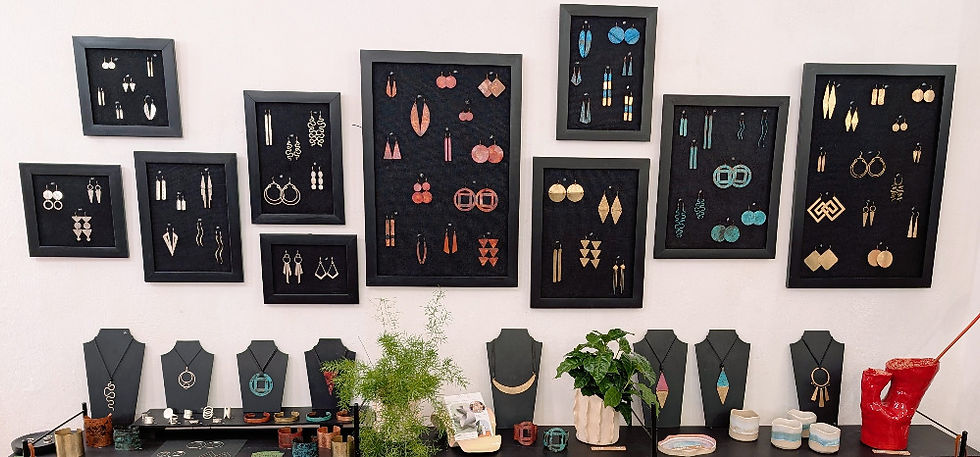
Peru had, and still has, an extraordinary silversmithing culture — talented makers, beautiful work everywhere. I wasn’t looking to compete with that. I was curious about what copper and brass could offer on their own terms: the idea of taking a metal considered ordinary, working it with care, and ending up with something that felt rare. That felt like the more interesting question. It led me, naturally, to patinas.
The problem was that in Lima at the time, patina chemicals weren’t easily available. Ordering from abroad meant navigating customs that were, let’s say, creatively unreliable. So I started searching for what could be done naturally, with what was around me.I read. I tested. I failed, a lot. It took months to get results that felt like anything. Even now, years later, it hasn’t become simple. Every time I move country, I start again: new climate, new water, new ingredients. The patina that worked in one city won’t behave the same somewhere else. Even in the same studio, with the same process, I can’t always predict the next batch. For every one that comes out right, two don’t. Sometimes I genuinely can’t say why. I just start again.
It’s slow. Sometimes maddening. I consider giving it up on a fairly regular basis.But then a piece emerges and I can’t. Because it’s unlike anything I could have planned — a surface that seems to hold something within it, a colour that didn’t quite exist before. That kind of result doesn’t come from a catalogue.
So when January came and silver had quadrupled, I was worried, yes. But underneath that, I felt quiet gratitude for those years spent with copper and brass, chasing something unpredictable for no other reason than that it was worth it.I’ve always been drawn to the idea of alchemy: turning something ordinary into something that carries value, not because the material is expensive but because of what’s been put into it — the design, the time, the process, the persistence. I haven’t found the philosopher’s stone yet, but I’m still looking.
A constraint, a long time ago, had quietly become the foundation of something.
Part 2 soon: what this winter made me rethink, and what’s coming out of the studio.Subscribe to be the first to hear about new collections and market dates.

Comments